

Helios M1/100 N/C MiniVent small room fan
189 €
Helios M1/100 N/C MiniVent small room fan


189 €
The Helios M1/100 N/C MiniVent axial bathroom fan keeps running for 6, 10, 15 or 21 minutes after the light is switched off, and in interval mode it ventilates automatically every 8, 12 or 24 hours. At low level its noise level at a distance of 3 metres is 25 dB(A), and at high level its volume flow is 90 cubic metres per hour at nominal width NW 100 — this is sufficient for an average bathroom of 6–10 square metres or a WC.
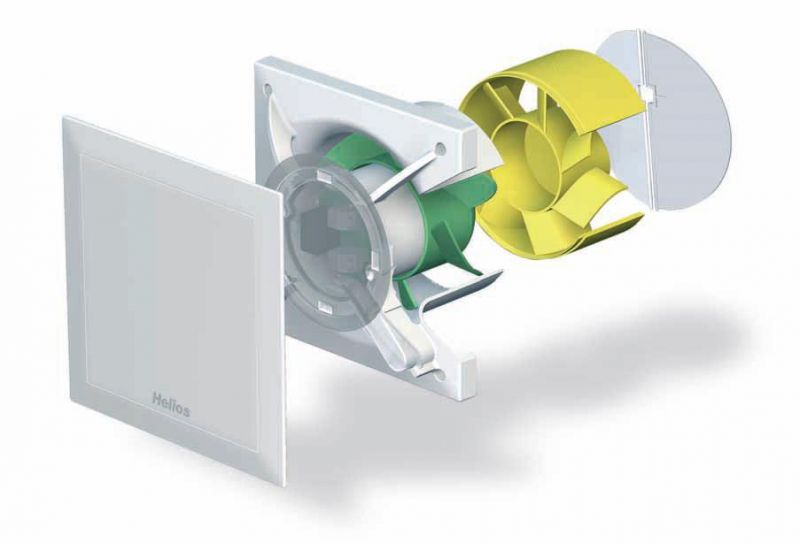
It is developed in Germany by Helios, its impeller runs on ball bearings, its connection spigot has a backdraught shutter fitted as standard, and its completely closed front facade conceals the dirty fan opening. With protection category IPX5 it can also be installed near the shower. Our expert staff will help you with sizing and choosing accessories.
Convenience Features
Convenience Features:
Max. Airflow
Max. Airflow:


Data
Type of Airflow:
Axial
Availability:
In stock
Diameter:
100
Convenience Features:
Run-on timer
Mounting Method:
Wall and ceiling
Noise Level:
Very quiet
Max. Airflow:
90 m3/h
Manufacturer:
Helios
Bearing Type:
Ball bearing
Speed Levels:
Multi-speed
Louvre:
Backdraught shutter
Pipe Insertable:
No
Protection:
IPX5
Colour:
White
Material:
Plastic housing
Max. pressure:
45 Pa
Voltage:
230
Size:
147 x 147
EAN:
4010184061724
Number of phases:
1
Motor poles:
2
Max. current consumption:
0.06 A
Weight:
0.80
Power consumption:
9 W
Rated speed (rpm):
2 650
Air temperature range (°C):
max. +40
Manufacturer's part number:
06172
Product family:
Helios MiniVent M1
Sound pressure at 3 m (dB(A)):
30

Professzionális bemutatóteremPróbálja ki termékeinket Budapesten, a Királyhágó utca 30. alatt

Ingyenes szaktanácsadásTapasztalt és segítőkész szakembereink várják hívását

Megbízható kereskedő32 év tapasztalatával az ország egyik legnagyobb forgalmazója

Díjnyertes vállalkozásDíjainkat és kiemelkedő értékeléseinket tisztességes üzletvitelünk miatt kaptuk
Details
Helios M1/100 N/C MiniVent: with turn-off delay and interval mode
The Helios M1/100 N/C MiniVent axial bathroom fan belongs to the premium class of the German manufacturer's small room fans, and this range is also the quietest in our own product line-up. At low level it moves 75 cubic metres of air per hour, and in this mode its noise level at a distance of 3 metres is 25 dB(A) — this is thanks to Helios ultraSilence technology. At high level its volume flow is 90 cubic metres per hour at nominal width NW 100, which is sufficient to ventilate an average bathroom of 6–10 square metres or a WC. If the air has to pass through a duct and an external shutter, this figure is lower: the manufacturer's figure is 60 cubic metres per hour at 31 pascals resistance.
What this version offers over the standard model is that it keeps running on its own for a while after the light is switched off, and if the room is not used for days, it still ventilates it from time to time. The turn-off delay is 6, 10, 15 or 21 minutes, the interval mode 8, 12 or 24 hours, and the start can be delayed by 0, 45, 90 or 120 seconds — so a quick hand wash does not start the fan. All three values are codeable inside the unit, with all electronic functions optionally adjustable at high or low level.
This is a premium class, high-end unit. We recommend it where every item, from the tiles through the sanitary ware to the doors and windows, has been carefully chosen, and the ventilation cannot be an exception either. The M1 series is developed in Germany by Helios; its front facade is completely closed, a multi-award-winning design, and air flows in from all sides — so it conceals the dirty fan opening, and the smooth-surfaced facade is easy to clean with a single wipe.
Data sheet
The official Helios catalogue page contains the technical data of all three sizes and every version of the MiniVent M1, the fan curves, the dimensional drawings and the wiring diagram numbers. It is useful for electricians, architects and anyone looking for precise data for the installation. The ref. no. of this version is 06172.
i
Did you know? If your bathroom has a suspended ceiling and you would route the ventilation duct above the ceiling, this is not the right choice — that calls for a centrifugal fan with a recessed casing, even if the duct run is short. The M1/100 is designed to ventilate through the wall, via a short duct, directly outdoors.
Technical data
Comparison of the four Ø100 versions; highlighted: the variant you are viewing.
| M1/100 | M1/100 N/C | M1/100 F | M1/100 P | ||
|---|---|---|---|---|---|
| Ref. no. | 06171 | 06172 | 06175 | 06174 | |
| Version | Standard model with two speed levels | Turn-off delay & interval mode | Humidity control function | Presence detector | |
| Flow rate free blowing | m³/h | 90 / 75 | |||
| Volume flow at 31 Pa resistance | m³/h | 60 | |||
| Maximum pressure | Pa | 45 | |||
| Power consumption | W | 9 / 5 | |||
| Rated current | A | 0.06 / 0.04 | |||
| Sound pressure level at 3 m | dB(A) | 30 / 25 | |||
| Speed | 1/min | 2650 / 2250 | |||
| Impeller diameter | mm | 92 | |||
| Connection spigot | mm | Ø100 | |||
| Voltage / frequency / phase | V / Hz | 230 / 50 / 1 | |||
| Turn-off delay time, adjustable | min | – | 6, 10, 15, 21 | 6, 12, 18, 24 | 6 |
| Interval mode, adjustable | h | – | 0, 8, 12, 24 | – | – |
| Start-up delay | s | – | 0, 45, 90, 120 | 0 or 45 | – |
| Humidity limit value, adjustable | % | – | – | 60, 70, 80, 90 | – |
| Backdraught shutter | Fitted as standard, removable | ||||
| Electrical supply line NYM-O | mm² | 3 × 1.5 | 4 × 1.5 | 4 × 1.5 | 3 × 1.5 |
| Wiring diagram no. | 915 | 917 | 919 | 918 | |
| Protection category | IPX5, protection class II | ||||
| Max. air flow temperature | °C | +40 | |||
| Weight | kg | 0.80 | |||
Dimensions
All dimensions in millimetres
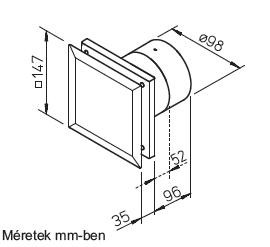
The facade measures 147 × 147 mm and projects 35 mm from the wall. The connection spigot is Ø98 mm, so it connects to a 100 mm duct. The unit is installed 96 mm deep in the wall; in case of restricted space conditions, the guide wheel can be removed, which reduces the installation depth to 52 mm. The drilling distance of the fastening screws is 116 mm.
Fan curve
Click the image to enlarge
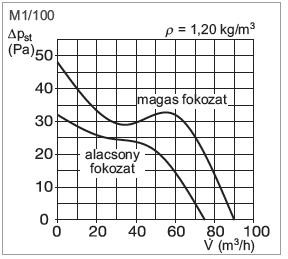
M1/100 — high and low level
The curve shows how much air the fan delivers as a function of back pressure, calculated for an air density of 1.20 kg/m³. Free blowing at high level it delivers 90 cubic metres per hour, at 31 pascals resistance 60 cubic metres per hour, and its maximum pressure is 45 pascals. The volume flow of the four Ø100 versions is identical — the difference lies in the electronics, not in the fan.
Why do we recommend it?
Turn-off delay and interval mode without a separate switch
The fan is started by the light switch, and the electronics take care of stopping it: it switches off automatically after the set 6, 10, 15 or 21 minutes. If the bathroom is not used for a longer period, the interval mode ventilates it every 8, 12 or 24 hours — this keeps the room dry in a holiday home or in a rarely used guest WC. No speed switch is needed, and a 4 × 1.5 mm² supply line is used for the electrical connection.
Two speed levels, 5 watts at low level
All M1/100 models come with two speed levels. At low level its power consumption is 5 watts at a volume flow of 75 cubic metres per hour — if it runs for 3 hours a day, that is about 5.5 kilowatt hours a year. At high level it is 9 watts and 90 cubic metres per hour. The electronic functions can be set at both levels.
The backdraught shutter is fitted as standard
The connection spigot contains the tight-closing backdraught shutter, which is not standard equipment in every small room fan. When the fan stops, the shutter closes, so no cold air is drawn into the room through the duct. The shutter can be removed if the installation requires it.
Ball-bearing motor for any mounting position
The ball bearings are designed for 40 000 operating hours, which allows installation in any position, even directly in the ceiling. The motor has thermal overload protection, and the manufacturer describes it as maintenance-free — however, regular cleaning of the impeller is needed for this fan too; without it, any fan will wear out sooner.
Also for wet room zone 1
It comes with jet water protection IPX5 and protection class II, so it can be installed in wet room zone 1 according to DIN VDE 0100-701, i.e. near the shower and the bath. The electrical connection is made easier by screwless connection terminals and the circumferential cable storage space of the casing.
Accessories for this product
For Ø100 installation, from our online shop
Frequently Asked Questions
At high level it moves 90 cubic metres of air per hour free blowing, which is sufficient to ventilate an average bathroom of 6–10 square metres or a WC. In practice, the back pressure of the duct and the external shutter reduces this figure: the manufacturer's figure is 60 cubic metres per hour at 31 pascals resistance. If the room is larger than this, or you would like more intensive extraction, call us — we will help you with sizing.
Inside the unit, by coding — the qualified electrician sets this during installation. The turn-off delay is 6, 10, 15 or 21 minutes, the interval mode 0, 8, 12 or 24 hours, and the start-up delay 0, 45, 90 or 120 seconds. No separate speed switch is needed, and all electronic functions are optionally adjustable at high or low level. The electrical connection requires a 4 × 1.5 mm² supply line, and the manufacturer's wiring diagram no. is 917.
The ventilation function is the same: it ventilates the room. The difference lies in the noise level, the build, the design, the materials and the electronics. At low level it is 25 dB(A) at a distance of 3 metres, its casing and facade are made of high-quality plastic, its impeller runs on ball bearings, and the backdraught shutter is fitted as standard in its spigot. It belongs where every item, from the tiles through the sanitary ware to the doors, has been chosen with care.
The ball-bearing motor is designed for 40 000 operating hours, so the unit works in any mounting position — even directly in the ceiling. However, if your bathroom has a suspended ceiling and you would route the ventilation duct above the ceiling, this is not the right choice: that calls for a centrifugal fan with a recessed casing, even if the duct run is short.
No. An axial fan cannot cope with the pressure in the shared riser: it either pushes the air back into the room or cannot carry it away. A shared riser requires a centrifugal, duct-system fan. This unit is designed to ventilate through the wall, via a short duct, directly outdoors.
Yes. The unit comes with jet water protection IPX5 and protection class II, so it can also be used in wet room zone 1 according to DIN VDE 0100-701 — that is, in the part of the wet room close to the shower. The electrical connection should be made by a qualified electrician.
We also recommend the following product as an accessory
Tartozékok ehhez a termékhez

Vásároljon Magyarország egyik legmegbízhatóbb légtechnikai áruházából
A Ventilátorház Budapest XVIII. kerületében, a Királyhágó utca 30. alatt található. Sokszoros díjnyertes cég vagyunk, több évtizedes tapasztalattal. A méretezésben és a tartozékok kiválasztásában szakértő munkatársaink segítenek — hívja őket a +36-70-369-9944 telefonszámon.


