

Helios M1/150 F MiniVent small room fan
470 €
Helios M1/150 F MiniVent small room fan


470 €
The Helios M1/150 F MiniVent is the largest axial small room fan in the range, with a humidity control function and a highly efficient EC motor. The activation threshold can be set between 40 and 90 per cent, and with the continuously variable humidity function the speed follows the room humidity. At low level it moves 220 cubic metres of air per hour from 6 watts, and its noise level at a distance of 3 metres is 35 dB(A); at high level it moves 260 cubic metres per hour.
It is developed in Germany by Helios, its impeller runs on ball bearings, the backdraught shutter is fitted as standard in its spigot, and its completely closed facade conceals the dirty fan opening. With protection category IPX5 it can also be installed near the shower. Our expert staff will help you with sizing and choosing accessories.
Convenience Features
Convenience Features:
Max. Airflow
Max. Airflow:


Data
Type of Airflow:
Axial
Availability:
Within 48 hours
Diameter:
150
Convenience Features:
Humidity-controlled
Mounting Method:
Wall and ceiling
Noise Level:
Quiet
Max. Airflow:
260 m3/h
Manufacturer:
Helios
Bearing Type:
Ball bearing
Speed Levels:
Multi-speed
Louvre:
Backdraught shutter
Pipe Insertable:
No
Protection:
IPX5
Colour:
White
Material:
Plastic housing
Max. pressure:
33 Pa
Voltage:
230
Size:
210 x 210
EAN:
4010184060437
Number of phases:
1
Motor poles:
EC
Max. current consumption:
0.08 A
Weight:
1.20
Power consumption:
9 W
Rated speed (rpm):
1 900
Air temperature range (°C):
max. +40
Manufacturer's part number:
06043
Product family:
Helios MiniVent M1
Sound pressure at 3 m (dB(A)):
35

Professzionális bemutatóteremPróbálja ki termékeinket Budapesten, a Királyhágó utca 30. alatt

Ingyenes szaktanácsadásTapasztalt és segítőkész szakembereink várják hívását

Megbízható kereskedő32 év tapasztalatával az ország egyik legnagyobb forgalmazója

Díjnyertes vállalkozásDíjainkat és kiemelkedő értékeléseinket tisztességes üzletvitelünk miatt kaptuk
Details
Helios M1/150 F MiniVent: with humidity sensor and EC motor
The Helios M1/150 F MiniVent axial small room fan is the largest size in the MiniVent range, and it is made with a highly efficient EC motor. At low level it moves 220 cubic metres of air per hour, and in this operating mode its noise level at a distance of 3 metres is 35 dB(A). At high level its volume flow is 260 cubic metres per hour; its connection spigot is Ø145 mm, so it connects to 150 ducts. This size is suitable for a room of approximately 20–30 square metres. If the air has to pass through a duct and an external shutter, the volume flow is lower: the manufacturer's figure is 180 cubic metres per hour at 31 pascals of resistance.
The humidity control of this version can do more than that of the smaller sizes: the activation threshold can be set anywhere between 40 and 90 per cent via a potentiometer, and you can choose between three operating modes. In one-stage mode it runs at one speed level, in two-stage mode it starts at low level and switches up when the humidity rises, and in variable mode the speed follows the room humidity. The turn-off delay is 6, 12, 18 or 24 minutes, and it can also be set separately for each speed level.
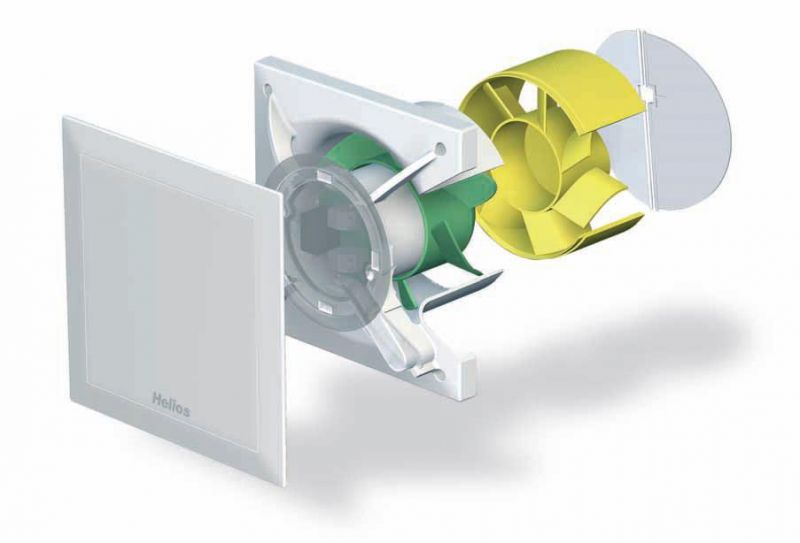
The manufacturer recommends this size for small to medium-sized rooms, in private buildings just as in commercial or industrial buildings: for bathrooms, washrooms, changing rooms, utility rooms and kitchenettes. This unit is not suitable for ventilating large retail premises, workshops or warehouses — they need an industrial fan, and we will gladly help you with that too. The M1 series is developed in Germany by Helios; its front facade is completely closed, a multi-award-winning design, and the air flows in from all sides — so it conceals the dirty fan opening, and the smooth surface can be kept clean with a single wipe.
Data sheet
The official Helios catalogue page contains the technical data of all three sizes and all versions of the MiniVent M1, the performance curves, the dimensional drawings and the wiring diagram numbers. It is useful for electricians, architects and anyone looking for precise data for the installation. The manufacturer's part number (ref. no.) of this version is 06043.
i
Did you know? If the room has a suspended ceiling and you want to route the ventilation duct above the ceiling, this is not the right choice — that calls for a centrifugal fan with a recessed casing, even if the duct run is short. The M1 is designed to ventilate through the wall, via a short duct, directly outdoors.
Technical data
The three Ø150 versions available in our shop; highlighted: the variant you are viewing.
| M1/150 | M1/150 N/C | M1/150 F | ||
|---|---|---|---|---|
| Ref. no. | 06041 | 06042 | 06043 | |
| Version | Standard model with two speed levels | Turn-off delay and interval mode | With humidity control function | |
| Motor | Highly efficient EC motor | |||
| Flow rate free blowing | m³/h | 260 / 220 | ||
| Volume flow at 31 Pa resistance | m³/h | 180 | ||
| Maximum pressure | Pa | 33 | ||
| Power consumption | W | 8 / 4.5 | 8 / 5 | 9 / 6 |
| Rated current | A | 0.08 / 0.06 | 0.10 / 0.09 | 0.08 / 0.06 |
| Sound pressure level at 3 m | dB(A) | 39 / 35 | ||
| Speed | 1/min | 1900 / 1600 | ||
| Impeller diameter | mm | 137 | ||
| Connection spigot | mm | Ø145 (for 150 ducts) | ||
| Voltage / frequency / phase | V / Hz | 230 / 50 / 1 | ||
| Turn-off delay time, adjustable | min | – | 6, 10, 15, 21 | 6, 12, 18, 24 |
| Interval mode, adjustable | h | – | 0, 8, 12, 24 | – |
| Start-up delay | s | – | 0, 45, 90, 120 | 0, 45, 90, 120 |
| Humidity limit value (via potentiometer) | % | – | – | 40–90 |
| Humidity function modes | – | – | one-stage, two-stage, variable | |
| Backdraught shutter | Fitted as standard, removable | |||
| Electrical supply line NYM-O | mm² | 3 × 1.5 | 4 × 1.5 | 4 × 1.5 |
| Wiring diagram no. | 1080 | 1081 | 1082 | |
| Protection category | IPX5, protection class II | |||
| Max. air flow temperature | °C | +40 | ||
| Weight | kg | 1.20 | ||
Dimensions
All dimensions in millimetres
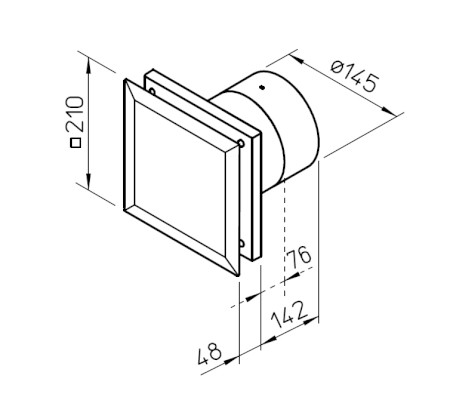
The facade measures 210 × 210 mm and projects 48 mm from the wall. The connection spigot is Ø145 mm. The unit is installed 142 mm deep into the wall; in case of restricted space conditions the guide wheel can be removed, which reduces the installation depth to 76 mm. The drilling distance of the fastening screws is 170 mm, and the required wall opening is 165 mm.
Performance curve
Click the image to enlarge
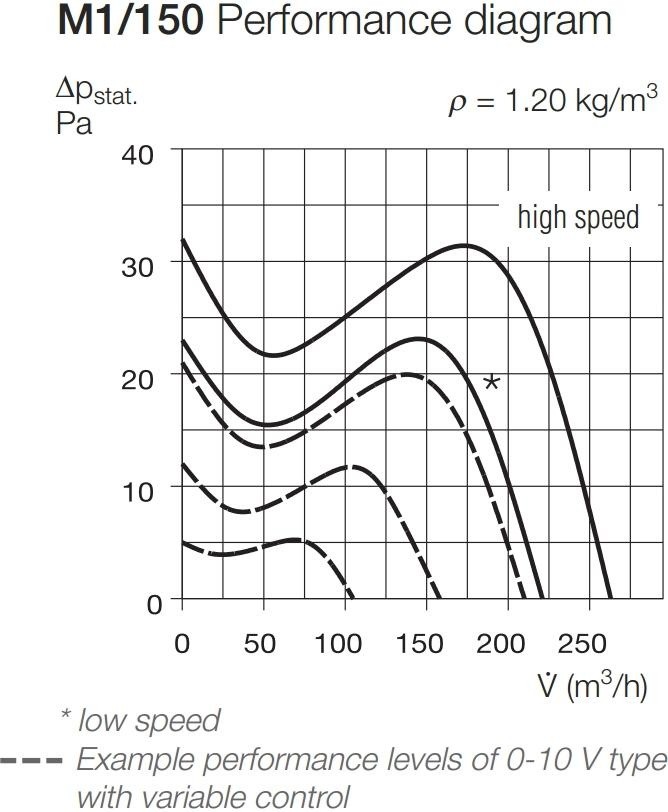
M1/150 — performance curve
The curve shows how much air the fan delivers as a function of the back pressure, calculated for an air density of 1.20 kg/m³. With free blowing at high level it delivers 260 cubic metres per hour, at 31 pascals of resistance 180 cubic metres per hour, and its maximum pressure is 33 pascals. The diagram also shows, as dashed lines, the levels of the 0-10 V controllable type; please ask our staff about that version.
Why do we recommend it?
Continuously variable humidity control, with EC motor
The EC motor is not only economical but also continuously variable — the third operating mode of the humidity control makes use of this: the fan runs as much as the humidity currently in the room requires, instead of switching between two extremes. At low level it delivers 220 cubic metres of air per hour with a power consumption of 6 watts, and at high level 260 cubic metres per hour from 9 watts.
The backdraught shutter is fitted as standard
The connection spigot contains the tight-closing backdraught shutter, which is not standard equipment in every small room fan. When the fan stops, the shutter closes, so no cold air is drawn into the room through the duct. The shutter can be removed if the installation requires it.
Ball-bearing motor, in any mounting position
The ball bearings are designed for 40 000 operating hours, so the unit works in any position, even directly in the ceiling. The motor has thermal overload protection, and the manufacturer describes it as maintenance-free — however, regular cleaning of the impeller is necessary for this fan too; without it, any fan wears out sooner.
Also for wet room zone 1
It is made with jet water protection IPX5 and protection class II, so it can be installed in zone 1 according to DIN VDE 0100-701, i.e. also near the shower and the bathtub. The electrical connection is made easier by screwless terminals and the circumferential cable storage space of the casing.
Accessories for this product
For Ø150 installation, from our online shop
Frequently Asked Questions
At high level, with free blowing, it moves 260 cubic metres of air per hour, which is sufficient for a room of approximately 20–30 square metres. In practice, the resistance of the duct run and the external shutter reduces this figure: the manufacturer's figure is 180 cubic metres per hour at 31 pascals of resistance. We will gladly help you with sizing.
The activation threshold can be set between 40 and 90 per cent via a potentiometer, and three operating modes can be selected: one-stage, two-stage (it starts at low level, then switches up when the humidity rises) and variable, in which the speed follows the room humidity. The turn-off delay is 6, 12, 18 or 24 minutes and can also be set separately for each speed level. The setting is carried out by a qualified electrician; the connection requires a 4 × 1.5 mm² cable, and the manufacturer's wiring diagram number is 1082.
Because the 150 size is made with a highly efficient EC motor, while the 100 and the 120 have an AC motor. The figures: at low level the 150 delivers 220 cubic metres per hour from 4.5 watts, the 120 delivers 150 cubic metres per hour from 10 watts, and the 100 delivers 75 cubic metres per hour from 5 watts. So the largest size not only delivers the most air, but also consumes the least per cubic metre.
The ball-bearing motor is designed for 40 000 operating hours, so the unit works in any mounting position — even directly in the ceiling. However, if there is a suspended ceiling and you want to route the ventilation duct above the ceiling, this is not the right choice: that calls for a centrifugal fan with a recessed casing, even if the duct run is short.
No. An axial fan cannot cope with the pressure in the common stack: either it pushes the air back into the room, or it cannot extract it. A common exhaust stack needs a centrifugal fan designed for duct systems. This unit is designed to ventilate through the wall, via a short duct, directly outdoors.
Yes. The unit is made with jet water protection IPX5 and protection class II, so it can also be used in zone 1 according to DIN VDE 0100-701 — i.e. also in the part of the wet room close to the shower. The electrical connection should be carried out by a qualified electrician.
We also recommend the following product as an accessory
Tartozékok ehhez a termékhez

Vásároljon Magyarország egyik legmegbízhatóbb légtechnikai áruházából
A Ventilátorház Budapest XVIII. kerületében, a Királyhágó utca 30. alatt található. Sokszoros díjnyertes cég vagyunk, több évtizedes tapasztalattal. A méretezésben és a tartozékok kiválasztásában szakértő munkatársaink segítenek — hívja őket a +36-70-369-9944 telefonszámon.


